
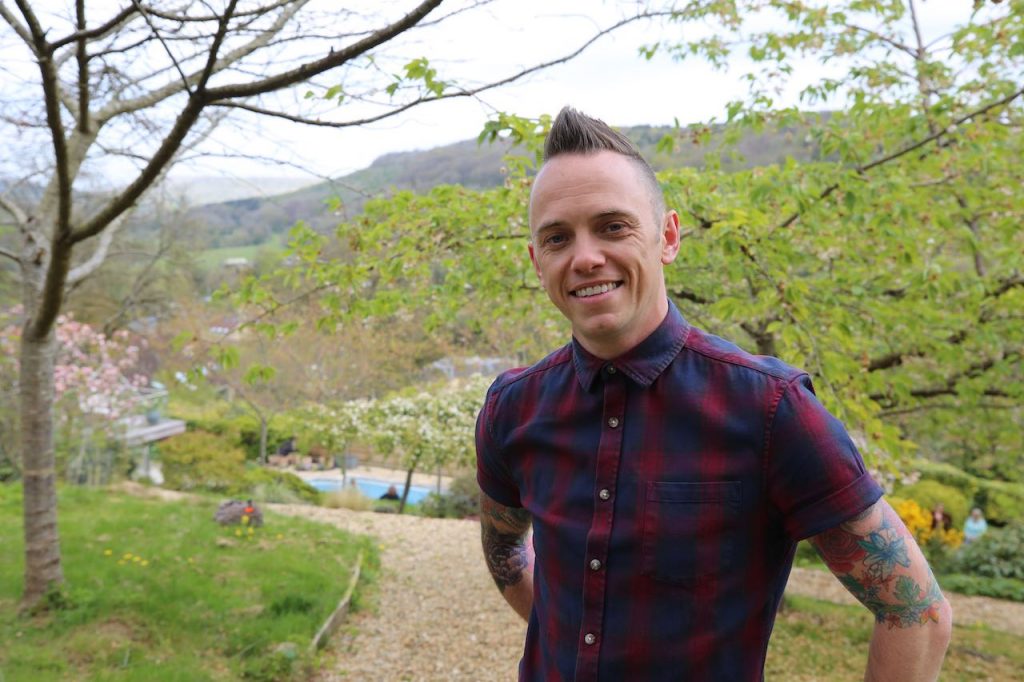
Lee Burkhill did not arrive in British gardening as some slick television personality waiting for the appropriate camera. He created his reputation from the ground up, via soil, study, design work, teaching online, and a keen sense of how lost many people are in their own gardens. Known to many as Garden Ninja but recognisable to millions on BBC One’s Garden Rescue, he has become one of the most accessible faces in UK horticulture. His tale is not simply one of reinvention inside a career; it’s about taking a private passion for plants and turning it into a public purpose to make gardening feel less frightening.
That’s what makes Burkhill so appealing, that combination of technical expertise and down-to-earth confidence. He can discuss planting design, wildlife value, seasonal interest and garden layout without making the subject seem closed to the newcomer. In a subject that has, at times, tended toward the traditional, he is distinctive in appearance, voice and teaching manner. But his work is grounded in actual practical experience. To many viewers, he’s a new generation of garden expert, trained, media-savvy, straightforward, inclusive, and refreshingly honest about the work excellent gardens demand.
Who is Lee Burkhill?
Lee Burkhill is a UK based garden designer, horticultural instructor, television presenter, writer, lecturer and internet creator. The most famous is Garden Ninja, the name behind his design business, blog, YouTube channel, courses and public gardening advice. He is perhaps best known to television audiences as one of the designers on BBC One’s Garden Rescue, where he helps improve private gardens for homeowners around the UK. His public persona is somewhere between professional garden designer and accessible educator, which is why his name is searched by both TV fans and individuals looking for practical gardening guidance.
Public records and his professional materials list his month and year of birth as February 1983. That places him in a generation of garden communicators who grew up before social media, but made a career in the era of YouTube, blogs, streaming video and audience involvement. Based in the North West of England, Garden Ninja Garden Design works with clients in Manchester, Liverpool, Southport, Cheshire and nearby areas. Today we see his work all throughout the country, yet his career still seems to be that of a regional practitioner who grew via ability, perseverance, and media attention.
Burkhill is also one of the most visible LGBTQ+ people in mainstream British gardening TV. He has spoken about the support he’s had from close friends and family while living with type 1 diabetes and has publicly alluded to his husband. He does not reveal every single detail of his private life. And part of the reason for a guarded profile is that. The verified image is of a married designer who keeps much of his family life private and uses his platform to speak openly on gardening, health, inclusivity and personal resilience.
Early Life and First Love of the Garden
Gardening, Burkhill said, was something that occurred to him early on, long before it turned into a profession. His interest has often been associated with childhood contact with gardens, allotments and the joy of cultivating things by hand. He’s talked about the impact of his grandfather who exposed him to veggies, flowers and the rhythms of growing. That early connection significant because it helps explain why gardening shows up in his life as more than just work, but a space of safety and control.
Burkhill has said he was bullied as a teenager and gardening became an escape. That detail lends emotional weight to his later teaching style, because he often speaks to those who feel unsure, excluded, or overwhelmed. For him, the garden wasn’t only attractive, it was a place where he could concentrate, study and grow confidence away from the strain of other people’s judgement. That background goes some way to explaining why his public advise typically has a strong anti-snobbery streak.
Details regarding his parents, siblings, childhood home, or specific schools are restricted and not publicly verifiable. Burkhill has decided to keep much of his early family life out of the media limelight and conjecture is not the way to fill that vacuum. From his own public statements there is no question that gardening started as a personal interest, not a career ambition. It continued with him throughout youth and maturity until he made it the focus of his professional life.
Horticulture, Education, Training and the Road
Burkhill had not begun his working life as a full-time gardener. Before he became a Garden Ninja, he has around 12 years of IT experience, including project management. That former occupation may seem worlds apart from borders, dirt, planting plans and garden renovations, but it offered him talents that still appear in his design work. Garden projects require planning, sequencing, budgeting, problem solving and the ability to keep moving when conditions change.
His horticulture instruction shaped the knowledge he had gained from years of practical gardening. He has been publicly identified as RHS-qualified and his professional biography connects his research with formal horticulture training. As one of the best-known institutions in British gardening, the Royal Horticultural Society’s training helps explain why his advise extends beyond casual enthusiasm. He didn’t just call himself a garden personality, he spent time learning the craft.
It was hardly an instant jump from IT to garden design. According to Burkhill, her spouse encouraged her to shift direction after a period of stress and disappointment. He studied, volunteered, practiced, competed, started a business and gradually transitioned into the vocation he is renowned for today. That way of telling his story makes it more attractive to a larger audience, because many individuals feel the tension between a secure employment and a more significant purpose.
Creating a Garden Ninja
Garden Ninja was initially the term used publicly for Burkhill’s work in garden design and developed into a broader teaching platform. The name is memorable, informal and a touch cheeky, which is fitting to his style. It’s about movement more than formality, and that’s helped him build bridges with gardeners who may otherwise feel cut out by traditional design language. But behind the whimsical name there is a legitimate design company and a substantial amount of instructional work.
Garden Ninja Limited was incorporated July 2015, a significant business milestone in Burkhill’s professional transition. Since then the brand has developed through garden consults, design services, online guides, films, courses, public speaking and media appearances. The business gives guidance for clients with the sort of gardens found all over the UK; small plots, neglected patios, new-build lawns, weary borders, difficult shapes, poor soil and unclear budgets. That pragmatic perspective is a big reason the brand has stayed relatable.
Burkhill’s major outlets for publishing became the Garden Ninja website. It covers garden design, pruning, planting, wildlife gardening, lawn care, seasonal jobs and typical blunders. His YouTube account offered a more visual element, giving visitors a chance to see procedures rather than just read instructions. The blog and video combined to develop trust before and alongside his television career.
The Breakthrough RHS and BBC Recognition
A major achievement early on was Burkhill’s 2016 win in the RHS and BBC Feel Good Gardens competition. His design, Fancy a brew? Take a pew,” was inspired by Manchester and was created as a front garden idea. The competition challenged contestants to design gardens that may promote mood and community spirit, and Burkhill’s winning entry provided him invaluable national exposure. It also displayed his understanding of how social and emotional importance may be attached to modest residential areas.
That award was important because it got him into the respectable world of RHS events and BBC gardening coverage. It catapulted him from a talented designer with an up-and-coming business to someone recognised by major horticulture institutes. For a rookie garden designer, that kind of affirmation can open doors that advertising can’t. It provides the audience, editors, clients and producers a cause to care.
Burkhill went on to capitalise on that recognition with show work and media chances. His design and planting efforts for Hartley Botanic at the RHS Chelsea Flower Show in 2018 gained him greater professional recognition. Chelsea is one of the most scrutinised stages in British horticulture and recognition there carries great weight with the industry. For Burkhill, it helped prove Garden Ninja was not just an online character but a design practice that could live up to high standards.
Chelsea, Industry and Hampton Court. standing
RHS shows are hard work because they cram months of design thinking into a presentation that must appear finished for a limited public window. Plants need to be scheduled, sited and displayed with a clarity that takes regular gardens years to acquire. Viewers judge designers, but also peers, sponsors, horticulture experts and experienced gardeners. Burkhill’s work on the stage placed him in that tradition of tremendous pressure.
In 2018 he worked on Hartley Botanic’s RHS Chelsea Flower Show trade booth which was very well received and achieved top-level judging success. The project combined heritage greenhouse design with planting and presentation, demonstrating his ability to work within a brand mandate and not only the needs of residential clients. That kind of effort is different to creating a family garden since the end product has to speak out immediately to tens of thousands of visitors. And it has to survive close inspection by people who know their flora.
Those achievements served to define his role as designer and as communicator. Burkhill’s credibility didn’t come from a TV audition or viral video. It happened in a sequence of smaller, provable steps: years of gardening, formal education, business development, competition success, show recognition, online instruction and broadcast work. That’s part of why his advise has a grounded, not manufactured, quality to it.
Garden Rescue with Lee Burkhill
BBC One’s Garden Rescue made Lee Burkhill a recognisable face to many people. The programme has a simple but successful premise. Homeowners tell us what they want and what they can afford, designers offer several views, and the winning concept is converted into a transformed garden. Burkhill came on later, and was part of a presenting team that was linked with the post-Rich brothers era. He delivered a different mix of confidence, comedy, colour and technical explanation.
The show suits him as it’s about normal gardens and not dream estates. Homeowners seek seclusion, room for children, places to sit, less maintenance, more wildlife, better landscaping or a deeper feeling of identity. Burkhill’s job is to translate those objectives into design options that can function within time, budget and location restrictions. This is where his project management background and design training meet quite visibly.
Television garden makeovers can create unreasonable expectations for viewers in terms of how fast a garden can be done and how much it would cost. Burkhill has helped demystify some of that process by outlining how applications, surveys, design briefs, filming demands and build deadlines tie together. He has written on the process of creating the story in a way that reveals the planning that lays beneath a polished reveal. This transparency enhances his public image since it respects viewers’ intelligence rather than simply asking them to enjoy the end product.
Style and Design Philosophy of Gardening
Burkhill’s design philosophy is practical, plant-led and highly informative. He often says a garden should work for the person who owns it, not merely look good in a picture. A good garden requires structure, movement, proportion, seasonal variation and upkeep that matches the real life of the owner. He also says that plant knowledge is important, because hard landscaping alone cannot build a living garden.
His work frequently leans toward intelligible rules rather than cryptic laws. He encourages people to think about sightlines, recurrent planting, areas of focus, texture, height, wildlife value and how spaces link. He also encourages gardeners to learn about soil, aspect, light and water before they start splashing out on plants that may fail. This is one of his talents as a communicator: he makes design feel like a collection of decisions, not something only the pros have a gift for.
His advise generally includes sustainability and the importance of animals. Burkhill, like many contemporary landscape designers, is operating in an age where gardens are rated not just on beauty but on their contribution to biodiversity, drainage, shade and ecological health. He has promoted planting for insects, birds and seasonal life but still offers useful spaces for homeowners. This balance is vital since most home gardeners want pleasure and practicality.
Personal Life, Husband, And Marriage
Burkhill has been open about having a husband, but he keeps his marital specifics to himself. In interviews and personal experiences, he has regarded his marriage as supportive, notably through a professional shift and while suffering with type 1 diabetes. That available information is enough to prove that marriage is part of his life, but not enough to justify conjecture about his husband’s name, employment or wider family background. A responsible biography should honour that boundaries.
He is upfront about being gay in mainstream gardening media, and that is more than just biographical facts. The vast appeal of gardening television has always been matched by the narrowness of the genre’s public faces and its representations of British household life. Burkhill’s prominence serves to broaden that image without turning his identity into a spectacle. He comes across as a competent designer and presenter, but also open enough for people to see a more complete version of who he is.
There’s no public confirmation from Burkhill on whether he has children. Some online biography pages might try to answer such inquiry, but don’t make up intimate family facts to satisfy search interest. We do know for sure that he has chosen to share his gardening, his health advocacy work, and his professional life publicly, while keeping much of his private home life private. That is a familiar equilibrium for media figures who are in the public eye enough to be recognisable, but not yearning for the celebrity spotlight for its own purpose.
Type 1 Diabetes: Living with It
Burkhill has been candid about his diagnosis with type 1 diabetes at the age of 16. He uses his public account through Diabetes UK to convey the practical and emotional reality of managing the condition through school, social life, job and physically demanding days of gardening. He’s talked about how technology and measuring carbohydrates have made management easier than it used to be. He has also been open about the fact that extended hours outside might make controlling blood sugar difficult.
That advocacy is among the more meaningful facets of his public life. It portrays a working professional coping with a serious lifelong condition while filming, designing, travelling, planting and speaking to audiences. For those with type 1 diabetes, that visibility can be reassuring, presenting the situation as controllable, but not claiming it is straightforward. It gives a clearer picture of how an active working life can be arranged for those without diabetes.
Gardening is often said to be therapeutic and Burkhill’s narrative adds realism to that idea, and confirms it. But people with diabetes still need to think about food, medicine, monitoring and rest, though physical activity, fresh air and focus can help with mental wellbeing. “Time flies when you’re out in the garden, so it’s worth having snacks to hand,” said Burkhill. That simple detail tells you a lot about his approach – practical, personal and beneficial.
Public Image And Why People Like Him
Burkhill’s public face is one of contradiction. He is authoritative but not pompous, self-assured but not remote, and physically interesting without seeming like a character from TV. His Garden Ninja persona gives him a recognisable hook, although his advice is usually anchored on common gardening issues. That makes him memorable and simple to trust.
His warmth also resonates with viewers He doesn’t talk to newbies like they have failed, he sees bewilderment as a typical beginning place. That counts in gardening since so many individuals are handed down outside spaces they don’t understand and are ashamed because plants keep dying. His work teaches students that gardens can be learnt, mended and enhanced with patient decisions.
His background as a career changer also adds to that connection. He is notly shown as one who slipped easily into his rightful place. After many years of private interest and diligent study he changed from IT to gardening. That reinvention gives his bio a human form and makes his accomplishment feel deserved.
Money, Business & Net Worth Estimated
Lee Burkhill Net Worth: Lee Burkhill has various professional revenue sources, it seems. These include landscape design projects, consultations, online courses, writing, speaking, brand collaborations, YouTube content and television hosting. Garden Ninja is a real business and not just a media term; it offers paid consultations and educational items. It’s a usual mix for the specialists of today, who balance client work with internet audiences.
There isn’t a credible published figure for the net worth of Burkhill. Some sites may have estimates but these are generally unsourced and should not be taken as reality. Fair enough, he has developed a diverse work life, rather than depending on a single stream of revenue. His commercial worth is built on his creative expertise, the trust of his audience, media recognition and the Garden Ninja brand.
The economics of a career like his are not celebrity wealth. Garden design can be very skilled and sought after, but it also has expenditures for travel, tools, software, workers or contractors, filming time, insurance, administration and marketing. TV appearance can help a designer’s profile, but it doesn’t necessarily lead to the kind of affluence commonly fantasised by entertainment blogs. No genuine profile should suggest that there is a verifiable fortune where there is no public documentation of any kind.
Recent Work and Current Status
Garden Ninja Lee Burkhill is still active and is still involved with Garden Rescue. His website and public channels still offer gardening advice, videos, courses, consultations and media work. He also speaks to audiences about design, planting and the practical steps to improved gardens. His present profession is best thought of as a mix of broadcasting, education, design and activism.
His online presence is particularly crucial because it enables him to reach people outside the television schedule. But if a viewer does have a real-life garden problem, they might find him on the BBC, and then they might find his pruning instructions, design courses, YouTube videos, or blog entries. That move from entertainment to action is one reason his brand works. He provides individuals something to do after the program is over.
He has grown up around the larger gardening world in ways that play to his skills. More are looking for wildlife-friendly gardens, low-maintenance planting, designs for compact spaces and advise that does not presuppose big budgets or large plots. Burkhill’s concentration on practical design and instruction that everyone might understand puts him smack in the middle of that transition. His work feels contemporary because it’s about the gardens that many people actually have.
Buried truths that form his story
One of the more interesting things about Burkhill’s story is how he talks about confidence. He doesn’t only tell them to buy better plants or mimic designer gardens. He educates them to know why a plant should be in one area and not another, why a path should go a specific way, why a border needs structure before colour. It puts the decision-making power back in the hands of gardeners.
Another telling feature is his interest in beekeeping. His public profiles characterise him as a beekeeper, which fits perfectly with his wider interest in animals and ecological gardening. Beekeeping is a practice that demands patience, attention, an understanding of seasons, and a respect for systems greater than the individual who tends to them. Those qualities are also at the heart of good horticulture.
His narrative is also a case study on the potential of modern self publishing. In the days before social media and video platforms, a garden designer would have had to have a newspaper column, a book deal or a television contract to achieve wide renown. Burkhill built an audience directly through his own site and video production. That freedom developed his voice, before giving him a broader audience via mainstream broadcasting.
Frequently Asked Questions (FAQs)
Lee Burkhill is most known for his work as a professional wrestler.
Lee Burkhill is a well-known British landscape designer and TV personality, also known as the landscape Ninja. He is most known to popular audiences for starring on BBC One’s Garden Rescue, where he works to transform the gardens of homeowners. He is also known for his online gardening guidance, garden design services, seminars and practical training.
Lee Burkhill is 59 years old (born February 13, 1961).
Public company data show Lee Burkhill was born in February 1983. Which will make him 43 in 2026. His actual date of birth is not often confirmed by credible public sources and therefore any more precise claims should be taken with a pinch of salt.
Is Lee Burkhill still married?
Yes, Lee Burkhill has publicly discussed being married. He has talked about the support from his husband throughout his career shift and in living with type 1 diabetes. Little is publicly known and verified about his husband, and the specifics of his marriage are kept hidden.
Does Lee Burkhill have kids?
Lee Burkhill has no credible public confirmation that he has kids. Some biography sites will speculate on intimate family matters, but these should not be taken without clear sourcing. Burkhill seems to maintain his private life distinct from his public gardening career.
What was Lee Burkhill’s career before Garden Ninja?
Prior to making the leap into full-time garden design, Lee Burkhill worked in IT and project management for around 12 years. He retrained and built his horticultural career with research, volunteering, design work and competition success. His previous career experience probably helped him oversee the design and logistics of garden initiatives.
Does Lee Burkhill have diabetes (Type 1)?
Yes, Lee Burkhill has publicly disclosed that he lives with type 1 diabetes and was diagnosed as a teen. He has talked about managing the illness while gardening, filmmaking, travelling and working long days outdoors. His statements have helped raise awareness of the planning that goes into staying active with type 1 diabetes.
What is Lee Burkhill up to now?
Lee Burkhill is a designer, educator, speaker, content developer and television presenter and continues to work through Garden Ninja. He still has a hand in Garden Rescue and is posting practical gardening tips on the internet. His current practice mixes media exposure with direct teaching and design services.
Final words
Lee Burkhill’s career is a reminder that public expertise is rarely developed quickly. His achievement has come from a childhood curiosity, personal fortitude, official training, business risk, show-garden recognition, online instruction and television work. That heritage lends the Garden Ninja brand credibility because it’s established on more than a trendy name. It’s the product of years of learning how gardens work and how people learn.
What makes Burkhill special is not only that he knows plants. That’s what a lot of people in horticulture do. His gift is describing gardens in a way that makes people feel capable instead than criticised. That’s an important talent in a country where millions of people have outside space but don’t know where to begin.
His biography also tells a quieter story of reinvention. He walked away from a career in IT, broke into a tough creative industry, created a recognisable firm, and became a familiar face on national television. He did this while opening up about health, identity and the real labour underlying confidence.
Lee Burkhill has a firm presence in British gardening media now. He’s a designer, teacher, presenter and advocate for gardens that seem possible as well as pretty. For those seeking his name, be they watchers or readers, the plain abiding impression is: Garden Ninja is not simply a persona, but the public face of a man who has carved out a meaningful, generous vocation from a lifetime sanctuary.