
Key Takeaways
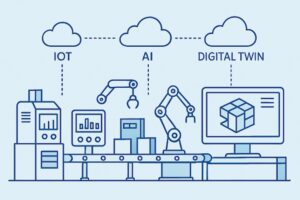
- Digital tools like IoT, AI, and digital twins are significantly enhancing factory efficiency.
- Predictive maintenance, enabled by AI and IoT, reduces downtime and maintenance costs.
- Digital twins allow for virtual simulations, optimizing production processes before physical implementation.
- Data analytics and AI-driven automation improve decision-making and operational efficiency.
Table of Contents
- Introduction
- IoT and Predictive Maintenance
- Digital Twins in Manufacturing
- AI-Driven Automation
- Data Analytics for Operational Efficiency
- Enhancing Quality Control with AI
- Challenges and Considerations
- Future Outlook
Modern factories are evolving rapidly as advanced digital tools make operations more intelligent, efficient, and resilient. The adoption of technologies such as the Internet of Things (IoT), Artificial Intelligence (AI), and digital twins allows manufacturers to refine processes and boost productivity in unprecedented ways. Central to this transformation is the effective use of manufacturing analytics software, which brings real-time data visibility and actionable insights directly to the shop floor. These solutions not only target bottlenecks and waste but also help streamline everything from predictive maintenance to quality control. Factories leveraging digital innovation are seeing impressive gains: fewer unplanned stoppages, reductions in maintenance costs, improved product quality, and greater agility to respond to market shifts. By enabling seamless communication between devices and harnessing the analytical power of AI, manufacturers worldwide are moving beyond traditional continuous improvement and embarking on true digital transformation. This combines efficiency with competitiveness, paving the way for the next generation of smart, connected factories.
IoT and Predictive Maintenance
One of the most significant shifts in the factory landscape is the deployment of IoT sensors on equipment. These sensors provide a constant stream of operational data—temperature, pressure, vibration, and more—across every phase of the production line. By funneling this data into advanced analytics systems, maintenance teams can monitor equipment health in real time and precisely predict when components are likely to fail. Predictive maintenance powered by IoT and AI reduces surprise breakdowns and scheduled downtime, lowering maintenance costs and keeping machines running optimally. For example, manufacturers can track subtle changes in motor behavior and intervene before a catastrophic breakdown occurs. Predictive maintenance programs can cut unplanned machinery outages by 30 to 50% while extending equipment life by up to 40%.
Digital Twins in Manufacturing
Digital twin technology is revolutionizing how factories plan, test, and optimize their processes. A digital twin is a virtual model of a factory asset or an entire workflow, updated in real time with live data from the physical version. This allows manufacturers to rapidly simulate everything from new assembly line layouts to process tweaks before making changes on the shop floor. The results are acceleration in innovation, higher efficiency, and significant reduction in trial-and-error downtime. Leading manufacturers such as BMW have reported reducing planning time by at least 25% after embracing digital twins. These sophisticated simulations highlight problems and inefficiencies early, so they can be corrected at the design stage, not after expensive production ramps up. This approach is enabling companies to stay more resilient and cost-effective in a changing global market.
AI-Driven Automation
Factory automation has evolved beyond simple robotics. Today, AI-driven automation integrates machine learning, enabling production robots and systems to learn and improve based on performance data. AI-powered robots can adjust their actions dynamically, identify anomalies, and even collaborate safely with human workers on complex assemblies. As a result, factories can expand their lines’ capabilities to produce diverse, high-quality products while driving down error rates and operational costs. This next-generation automation does not just replace human effort but augments it, freeing workers to focus on innovation and more value-adding tasks. This synergy between human and machine intelligence is key for adapting to market demands and shortening product development cycles.
Data Analytics for Operational Efficiency
Manufacturing analytics solutions are now at the heart of operational improvement strategies for forward-thinking plants. These platforms aggregate and analyze data from across the production ecosystem, allowing managers to spot inefficiencies and optimize every resource in real time. By reviewing historical trends and live feeds from machines, analytics help to root out causes of waste, bottlenecks, and bottlenecked workflows affecting output and cost structures.
Adopting a comprehensive data strategy, factories have reported increasing overall equipment effectiveness (OEE) rates to 85%, far above the 60% industry average. Live dashboards and alerting systems quickly guide personnel to the highest-impact improvements, supporting data-driven decision-making at every level of the organization.
Enhancing Quality Control with AI
Quality assurance teams traditionally relied on manual inspection to find defects, a process that is labor-intensive and prone to human error. AI-driven quality control systems now use real-time data, including computer vision, to rapidly detect flaws, deviations, or inconsistencies far quicker and more reliably than people. These systems continuously learn as they process new data, improving their detection capabilities over time and allowing factories to maintain higher standards with fewer resources. AI-powered quality inspection minimizes recalls and waste and frees human staff to address more complex problem-solving and value-adding activities. This shift towards intelligent inspection is defining the new benchmark in manufacturing quality and compliance standards.
Challenges and Considerations
With all the promise of digital tools, manufacturers face important considerations in their adoption. Data privacy remains a top concern, as more sensitive production data is stored and transferred digitally. Investments in robust cybersecurity measures are critical to guard against breaches, intellectual property theft, and operational disruptions. Additionally, the upfront cost and complexity of integrating new digital solutions can be significant, especially for legacy plants. Success relies on comprehensive planning, staff training, and strong change management. Ensuring all employees are aligned with new systems and understand their benefits is essential for maximizing return on investment and minimizing resistance on the shop floor.
Future Outlook
The next decade in manufacturing will be defined by the scaling and interconnection of these digital tools, blending the power of AI, IoT, and digital twins into a seamless fabric, creating factories that are not only more productive but also increasingly agile and sustainable. As the demand for greater traceability, product variety, and operational flexibility grows, manufacturers must continue to embrace transformative technologies to maintain their competitive edge and meet the expectations of tomorrow’s market.