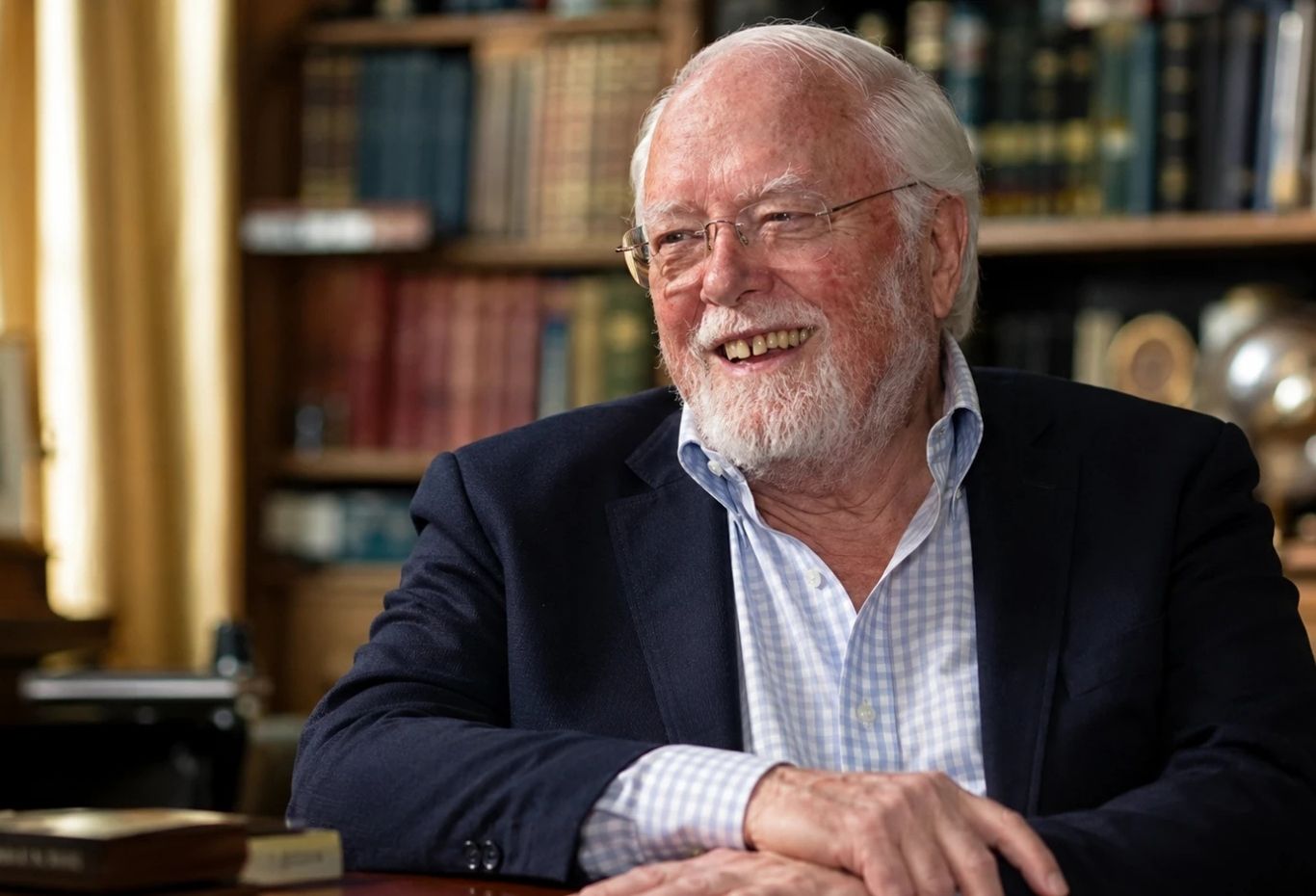
He does not have the global fame of his father, Sir David Attenborough, whose voice is a staple of documentaries that have helped millions of people understand the globe. Still, Robert Attenborough’s life has its own quietly intriguing story, centred in science, intense curiosity and academic excellence, not media cameras. In 2026, Robert, now 74, is a man who chose the life of research and intellect as his family’s name flashed across screens and stages around the world. That disparity is part of why Robert’s life is worth knowing for its own sake.
A Scientist With a Personal Life
Robert Attenborough was born in August 1951, into a home that already had an education and a scientific curiosity about it. His father, Sir David Frederick Attenborough, was starting out as a broadcaster when Robert was a toddler, and his mother, Jane Elizabeth Ebsworth Oriel, was a constant presence in family life until her death in 1997. Robert’s younger sister, Susan, would become a primary school teacher, but Robert was interested in the biological sciences.
Robert, the son of one of the most recognisable natural history broadcasters of the 20th and 21st centuries, made his career away from the spotlight. David’s work made him world famous but Robert’s was about human biology and evolution. Public sources and academic profiles list his birth month and year as August 1951, meaning Robert is 74 years old in 2026.
Family and Early Life
The Attenborough home in the mid-20th century was full of books, curiosity and academic stimulation. Their father was already cultivating his own scientific interests and broadcasting ambitions and pushed both children to think carefully about the world. For Robert this meant early absorption not in television production, but in natural science and anthropology. Robert was raised in an educationally orientated family that instilled in him a lifetime passion to scholarship.
His parents’ marriage, which started in 1950, lasted over fifty years until Jane’s death in 1997. Robert and Susan grew up with the same combination of intellectual involvement and love that David and Jane’s relationship had. David’s memoirs and interviews through the years show a profound respect for his children and at times a mild regret at missing family moments when on long filmmaking trips. But these early years, formed in a house that valued curiosity, would prepare the ground for Robert’s future career in science.
Opting For Academia Rather Than Fame
Unlike many offspring of famous parents, Robert Attenborough never courted public fame. Instead, he sought university credentials in biological anthropology, a field that combines human biology, evolution and population studies. His work is based in human population biology and health, with a particular interest in study on human communities in the Asia-Pacific region, particularly Papua New Guinea.
Robert spent most of his professional life at the Australian National University (ANU) in Canberra, where he was a senior lecturer in bioanthropology. He was known there by students and colleagues as a dedicated teacher and researcher whose courses and mentorship touched a generation of students of biological anthropology. In addition to his teaching, Robert contributed to establish a curriculum that enhanced the prominence of the discipline at ANU by incorporating human variation, physiology and behavioural ecology into academic programs.
Although he stepped down from full-time duties in 2013, Robert’s academic influence continued through research contributions and collaborations, and through his appointment as Senior Fellow at the McDonald Institute for Archaeological Research at the University of Cambridge. That Cambridge connection is a reminder of a decades-long, continent-spanning association with hard scholarship.
Research Interest: Populations & People
Robert’s scientific contributions are often on themes of human biology, adaption and how populations develop over time. He is an author or co-author of several chapters and journal publications, particularly on studies of New Guinea’s genetic history and human demography. He is engaged in a worldwide debate over human evolutionary history, including publications on themes such as regional population dynamics, ancient DNA and environmental adaptation.
This concentration on human populations is Robert’s scientific identity from his father’s popular animal documentaries. While David’s voice recounted the tale of animal life and planet-scale ecosystems to the general public, Robert’s work addressed the intersection of human biology with environment, culture and evolutionary pressures. Both careers—popular scientific communication and academic anthropology—are expressions of mutual curiosity, but in very different ways.
Life Outside the Headlines
Robert has kept his solitude and avoided building a public character, despite the weight of his father’s reputation, especially as Sir David marked his 100th birthday in 2026. Sir David’s centenary and broadcasting milestones are often celebrated in the media and documented in retrospectives, but Robert’s name is more likely to appear in academic directories and research profiles than tabloids or entertainment sites.
There is little publicly available information regarding his personal circumstances (marriage status, children or interests). Robert’s daily habits are outside the glare of popular media, unlike famous actors or broadcasters whose family connections and personal routines are regularly chronicled. Such isolation fits his work life, which is based on long-term study, teaching and collaboration rather than spectacle.
Research and Academic Impact
In education, depth and longevity matter more than sound bites. That ethos is reflected in Robert’s career. As an instructor he taught key themes like human variety and evolutionary perspectives of human behaviour. He helped establish programs that helped students combine biological facts with anthropological ideas — work often done over years and through peer-reviewed research rather than front-page news.
His links with prominent research institutes such as ANU and Cambridge also testify to the esteem he enjoys among his peers in the academic world. He is a Senior Fellow at the McDonald Institute for Archaeological Research, where he joins colleagues who investigate human evolutionary history based on archaeological evidence, anthropological theory and biological data.
Robert’s work on Papua New Guinea is still relevant since the populations there tell us about global patterns of human variation. Papua New Guinea’s staggering genetic, cultural, and environmental diversity offers a fertile ground for researchers to examine how humans have evolved to some of the most diverse places on Earth, which makes Robert’s contributions all the more valuable.
Family Ties & Legacy
With affection, Robert is singled out in family reminiscences gathered in the course of the conversations with Sir David. One anecdote that parallels the Attenborough love of wildlife is that Sir David had once given Robert a salamander on his eighth birthday, having himself been given similar curiosities by his own father in his youth. That story shows the warmth of family and the continuing theme of curiosity about life, human or animal.
The work of Sir David in nature broadcasting and education has made the Attenborough name of worldwide importance. But the family’s influence stretches into other areas – arts, science, conservation and academics – through members who have made their own names in disparate fields. For example, Robert’s sister, Susan, has taken her own path to education and community influence.
Robert’s career started in a world less connected by digital media than it is today, yet he has established a life that spans cultures and continents, from England to Australia and back via academic links to Cambridge. In this sense his work has a truly worldwide intellectual impact, even if it has never been broadcast to millions at once.
What Is Robert Attenborough Doing Now
Robert Attenborough is still actively involved in academic research, consultation and intellectual discussion (date up to 2026). His formal retirement from the classroom has not represented a total retreat from his field. His work continues to be cited by fellow anthropologists and organisations, and his listing in the McDonald Institute directory at Cambridge shows ongoing involvement in research and mentoring.
Robert’s accomplishments, unlike his father’s, are not evaluated in broad audiences but in academic impact, collegial esteem and the pupils he helped develop. And that disparity is as much a reflection of the choices he took as it is of the nature of life scientific in the present period.
Common questions
How old is Robert Attenborough?
Robert Attenborough will be 74 years old in 2026. He was born in August 1951.
Who are the parents of Robert Attenborough?
His father was broadcaster and natural historian Sir David Frederick Attenborough and his mother was Jane Elizabeth Ebsworth Oriel.
Robert Attenborough is an Actor. Actor
Robert Attenborough is a biological anthropologist and professor who was a senior lecturer at the Australian National University and is a Senior Fellow at the McDonald Institute for Archaeological Research.
Is Robert Attenborough a celebrity?
He is a public academic in his area, but not a star. His work life is less well chronicled in the public media than in scholarly directories.
Robert Attenborough is a Londoner.
He has lived in Canberra, Australia for many years, where he worked at ANU, and has contacts with the University of Cambridge.
Robert is a father.
There are no reliable public sources that provide definite information regarding his children or family life, other than his own biography and work.
Why is Robert not so well recognised as his father?
Instead of going into public television, which naturally receives less media attention globally, Robert opted to go into university. That’s a personal choice, a professional option, a choice of research over public performance.
Summary
A life of quiet academic concentration in a family famous for public discussion about nature. In 2026, aged 74, his work in biological anthropology continues the Attenborough legacy into the study of humanity itself. His academic achievements show us that impact does not always come through fame, but through continued interest and creation of knowledge over generations. While the world justifiably celebrates his father’s century of storytelling, Robert’s contribution is an understated, but essential chapter in a wonderful family narrative.